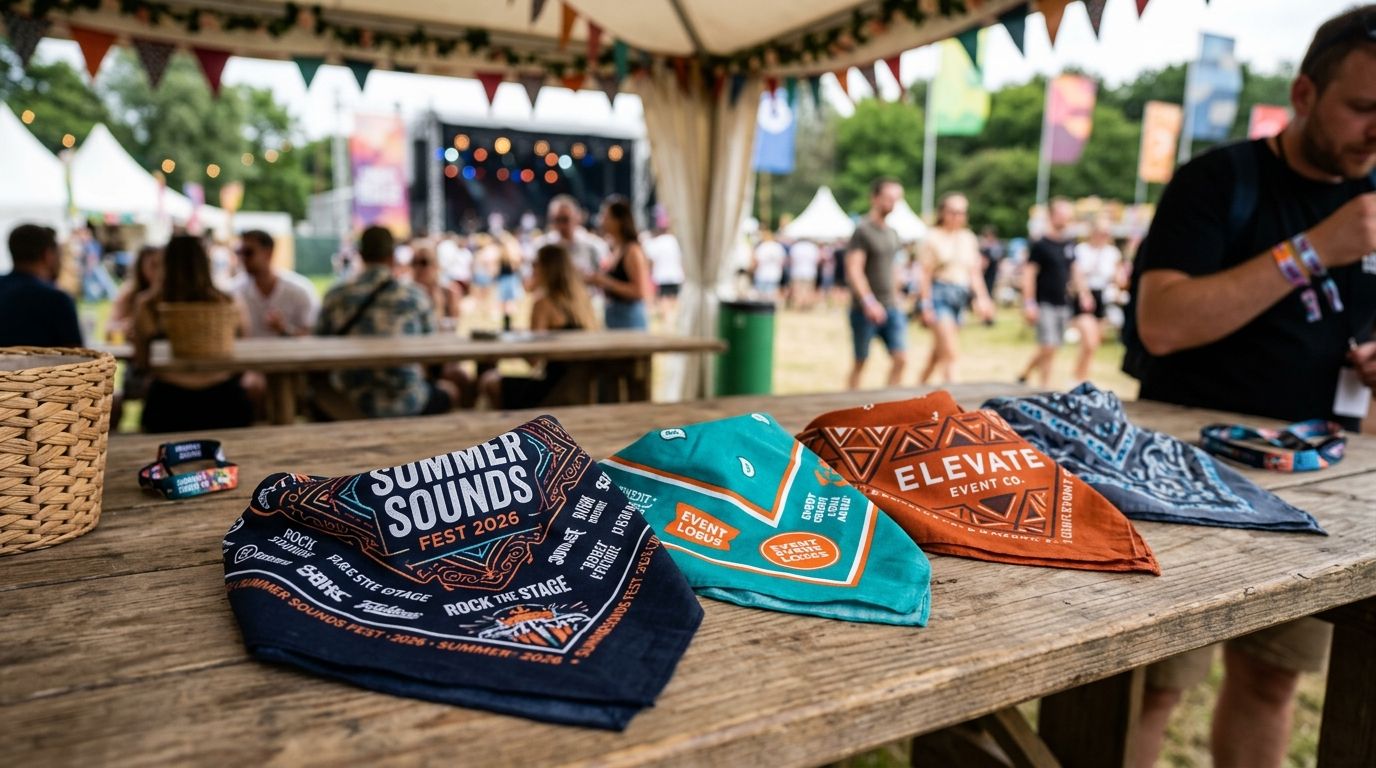
Custom printed bandanas for events come down to one choice: which printing method fits your headcount, deadline, and design. Best overall: screen-printed bandanas for bulk event orders. Best for full-color or photo-quality art: dye-sublimation printed bandanas. Best budget option: single-color digital print bandanas. Best for premium, long-wear branding: embroidered bandanas.
- Screen-printed bandanas win for events ordering 100+ units on a fixed logo or slogan.
- Dye-sublimation is the only method that reproduces full-color photo-style art edge to edge.
- Embroidered bandanas cost more per unit but hold up through repeated washes far better than printed ones.
- Single-color digital print bandanas are the fastest, cheapest path for small runs under 50 pieces.
- Pre-printed stock pattern bandanas with a custom tag skip design time entirely for last-minute events.
Why this matters
Most event organizers pick a bandana printing method based on price alone, then find out too late that the design doesn't survive a wash or the turnaround blows the event date. The method you choose changes cost, color range, and durability at the same time — you can't optimize for all three.
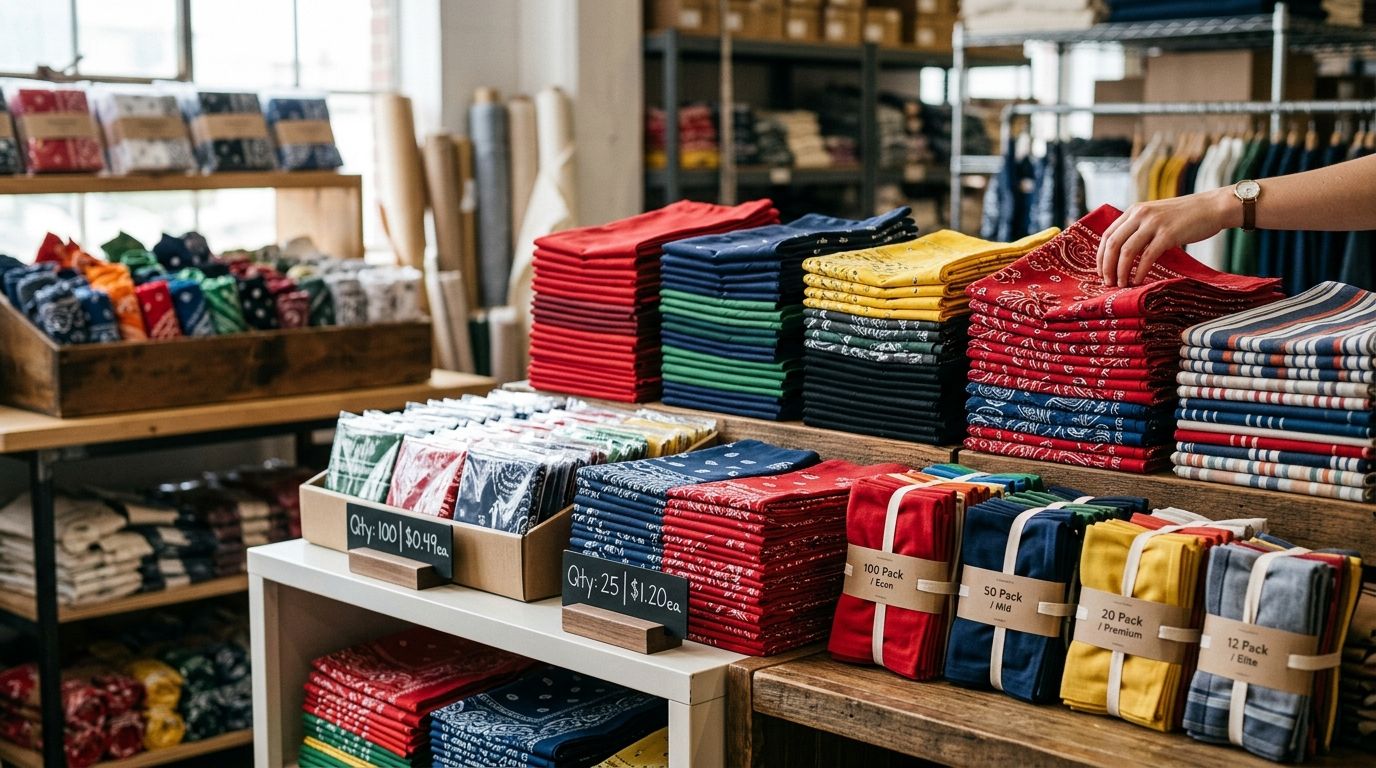
Wholesale For Everyone works with schools, event planners, fundraisers, and resellers ordering custom printed bandanas for events at every quantity level, and the pattern is consistent: the right method depends on your order size and your art, not on which option sounds premium. If you're comparing quantity breaks directly, the bulk bandanas ranked by price and quantity guide lays out where each tier starts paying off.
What makes the best custom printed bandanas for events
- Minimum order quantity — how low you can go without the per-unit cost spiking
- Color and design capability — how close the print matches full-color art versus a flat logo
- Turnaround time — how many business days between art approval and shipment
- Wash and wear durability — whether the design survives the event and gets reworn afterward
- Cost efficiency at volume — how the per-piece price moves as quantity climbs
- Design flexibility — whether all-over patterns, gradients, or photo art are even possible with the method
Custom printed bandanas for events at a glance
| Method | Best for | Standout feature | Key limitation |
|---|---|---|---|
| Screen-printed bandanas | Large bulk event orders | Lowest per-unit cost at high volume | Each additional color adds setup cost |
| Dye-sublimation printed bandanas | Full-color, photo-quality designs | Edge-to-edge, all-over color with no fabric feel | Higher per-unit cost than screen printing |
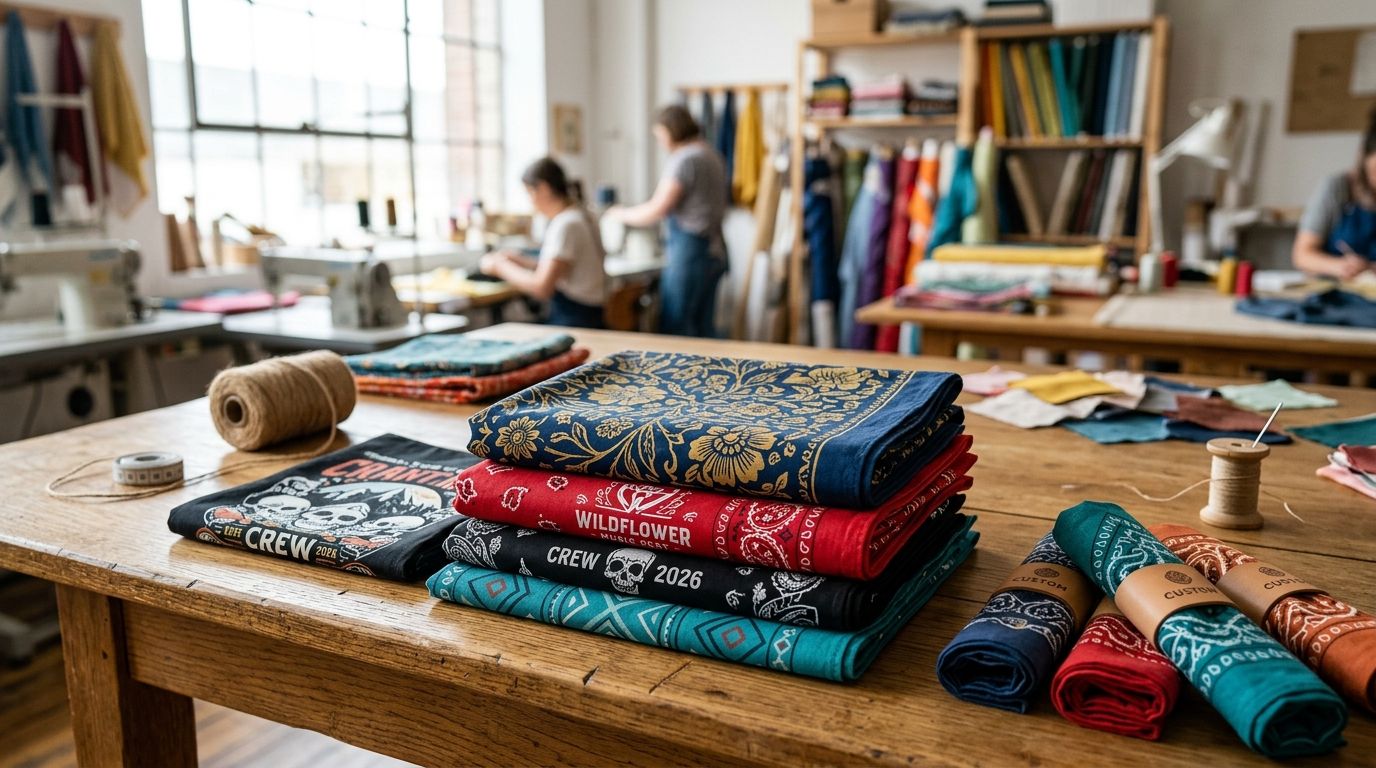
| Embroidered bandanas | Premium, long-wear branding | Design survives dozens of washes | Not suited to fine detail or gradients |
| Single-color digital print bandanas | Tight budgets, small runs | Low minimums, fast approval | Limited to one or two flat colors |
| Pre-printed stock pattern bandanas with tag | Fast turnaround, no design work | Ships without art proofing delays | No custom graphic on the bandana face itself |
1. Screen-printed bandanas: best custom printed bandanas for large event orders
Screen printing pushes ink through a mesh stencil onto the fabric, one color layer at a time. For a single-color or two-color logo run in the hundreds, this is the most cost-efficient method Wholesale For Everyone offers, and it's the default recommendation for races, fundraisers, and team giveaways.
Screen-printed bandanas pros:
- Lowest per-unit cost once you clear the bulk quantity threshold
- Holds up well through repeated wear and washing
- Fast reorders once the screen is set up
Screen-printed bandanas cons:
- Each extra color requires a new screen, which adds setup cost
- Not built for gradients, photo art, or fine detail
- Small orders under the minimum don't get the per-unit savings
Screen-printed bandanas best for: organizations ordering 100 or more bandanas with a simple one- or two-color logo. Verdict: Buy.
2. Dye-sublimation printed bandanas: best for full-color and photo-quality event designs
Dye-sublimation prints the design directly into the fiber using heat, which means it can reproduce full-color art, gradients, and photo-style graphics that screen printing can't touch. This is the method to pick when the design has more than two or three colors or covers the entire bandana face.
Dye-sublimation bandanas pros:
- Handles unlimited colors and gradients in a single pass
- Print sits in the fabric instead of on top of it, so it doesn't crack or peel
- Works for all-over patterns, not just a logo in a corner
Dye-sublimation bandanas cons:
- Costs more per unit than screen printing at the same quantity
- Best suited to polyester or poly-blend fabric rather than 100% cotton
- Overkill for a plain one-color logo job
Dye-sublimation bandanas best for: brand launches, sponsor-heavy event merchandise, or any design with photo-quality art. Verdict: Buy.
3. Embroidered bandanas: best for premium, long-wear event branding
Embroidery stitches the design into the fabric rather than printing on it, which is why it survives years of washing without fading. It's the slowest and most expensive of the five methods here, so it fits events where the bandana is meant to be worn long after the event ends — staff uniforms, retail resale, or brand ambassador kits.
Embroidered bandanas pros:
- Design never fades, cracks, or washes out
- Reads as a premium product versus a printed giveaway
- Works well on both cotton and poly-blend fabric
Embroidered bandanas cons:
- Highest per-unit cost of the five methods
- Can't reproduce gradients, photo art, or fine text
- Longer production lead time than screen or digital printing
Embroidered bandanas best for: organizations that want the bandana to double as long-term branded merchandise rather than a one-event giveaway. Verdict: Hold — use it when budget and lead time both allow.
4. Single-color digital print bandanas: best for tight budgets and small runs
Digital printing skips the screen-setup step entirely, which makes it the fastest and cheapest way to get a small batch of custom printed bandanas for events out the door. It's built for one or two flat colors, not detailed art, but for a small fundraiser or a last-minute team order it beats every other method on speed and minimum order size.
Single-color digital print bandanas pros:
- Lowest minimum order quantity of any method here
- No setup cost, so small runs stay affordable
- Fast turnaround from art approval to production
Single-color digital print bandanas cons:
- Limited to one or two flat colors
- Not suited to gradients or photo-style art
- Per-unit cost doesn't drop much even at higher quantities
Single-color digital print bandanas best for: small fundraisers, PTA events, or any order under 50 pieces on a tight timeline. Verdict: Buy — for small, fast orders specifically.
5. Pre-printed stock pattern bandanas with tag add-on: best for fast turnaround, no design work
Some events don't need a custom graphic at all — a classic paisley or bandana-print pattern (the standard bandana is typically a 22-inch by 22-inch cotton square) with a small custom tag or sewn-in label covers the branding need without waiting on art proofing. This is the fastest path to shipped product when the event date is close.
Pre-printed stock pattern bandanas pros:
- No art approval delay, since the pattern is already set
- Fastest shipping timeline of any option on this list
- Lowest cost when a custom graphic isn't required
Pre-printed stock pattern bandanas cons:
- No custom design on the bandana face itself, only the tag
- Pattern and colorway options are limited to what's in stock
- Doesn't work if the event needs a visible logo on the fabric
Pre-printed stock pattern bandanas best for: events days away with no time for a design cycle. Verdict: Wait — only when a custom face design isn't required.
Get a custom bandana quote for your event
Tell Wholesale For Everyone your quantity, deadline, and design and get a method recommendation.
How this ranking works
Each method above is scored against the same six criteria: minimum order quantity, color and design capability, turnaround time, wash durability, cost at volume, and design flexibility. No method wins on all six — that's why the ranking splits by use case instead of naming one universal winner. If you're sourcing bandanas for a school fundraiser or youth group specifically, the bulk bandanas for schools and youth groups breakdown applies the same criteria to that buyer.
Which custom printed bandanas should you choose for your event?
For most events ordering in bulk with a simple logo, screen-printed bandanas are the default pick for 2026 — the per-unit math works in your favor past a few dozen units. If your design has more than two colors or covers the whole bandana, move to dye-sublimation. If the bandana needs to survive years of wear as ongoing merchandise, embroidery is worth the extra cost and lead time. Small, fast, budget-limited orders belong with single-color digital printing, and last-minute events with no design cycle should default to a pre-printed stock pattern with a custom tag.
Working with more than one supplier before deciding? The wholesale bandana suppliers comparison walks through how minimum order quantities and turnaround windows vary supplier to supplier heading into 2026.
FAQ
What's the best custom printed bandana option for large events?
Screen-printed bandanas are the best option for large events in 2026 because the per-unit cost drops significantly once you clear bulk quantity, provided the design uses one or two colors.
Is screen printing better than dye sublimation for bandanas?
Screen printing is better for simple, one- or two-color logos at high volume, while dye sublimation is better for full-color, gradient, or photo-style designs. Neither method is better across the board; it depends on the art.
How many colors can you print on a bandana?
Screen printing typically handles one to three colors economically before setup costs climb, while dye-sublimation printing has no practical color limit since it prints full-color art directly into the fabric.
What's the minimum order for custom printed bandanas?
Minimums vary by method — digital printing and pre-printed stock patterns generally allow the smallest runs, while screen printing becomes cost-effective at higher quantities. Check current minimums directly before ordering.
Do custom bandanas work for school events and fundraisers?
Yes, custom printed bandanas are common for school events and fundraisers, and screen printing or single-color digital printing typically fits school budgets best since both keep per-unit cost low at moderate quantities.
How long does custom bandana printing take before an event?
Turnaround depends on the method: pre-printed stock patterns ship fastest since there's no art proofing step, while screen printing and embroidery need more lead time for setup and stitching. Confirm the production window against your event date before ordering.
Can you put a full-color logo on a bandana?
Yes, dye-sublimation printing reproduces full-color logos and photo-style art edge to edge on the bandana, which screen printing cannot match without adding a separate screen per color.
Are embroidered bandanas more durable than printed ones?
Yes, embroidered bandanas hold up better through repeated washing since the design is stitched into the fabric rather than sitting on top of it, but embroidery costs more per unit and can't reproduce fine detail or gradients.
One last thing
A standard bandana is a 22-inch by 22-inch cotton square — that fixed size is why the printing method matters more than the fabric choice for most event orders. Pick the method that matches your color count and quantity first; the fabric decision almost always follows from there.