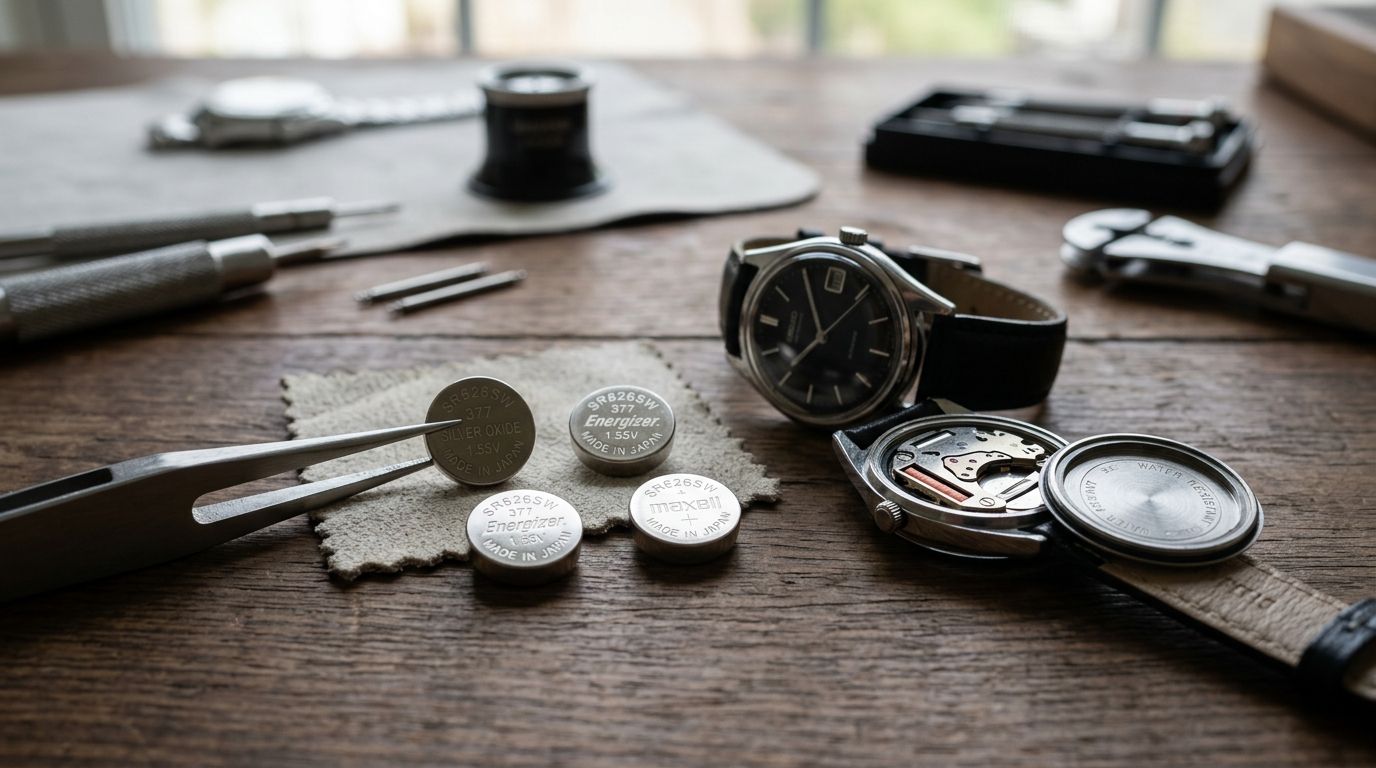
Silver oxide watch batteries power most analog quartz watches sold in 2026, and grabbing the wrong brand or the wrong size code can leave you with a dead watch face or a corroded battery compartment. This guide ranks six widely available silver oxide button-cell lines by the job each one does best, so you buy once and buy right.
- Renata wins overall among silver oxide watch batteries in 2026 — Swiss-made cells built to original watchmaker spec.
- Energizer is the best budget pick for drugstore-level bulk buying without sacrificing voltage stability.
- Murata (formerly Sony) leads for high-drain chronographs and multi-function watch movements.
- All silver oxide cells output a flat 1.55V, so match the size code (377, 371, 626, 344) before you worry about brand.
- Panasonic is the strongest fit for resellers and shop owners buying in bulk for a retail counter.
Why this matters
Silver oxide chemistry holds a flat discharge curve for most of its life, then drops off fast — that is why a watch runs at full accuracy right up until the moment it stops, instead of slowing down first. Alkaline button cells decline gradually instead, which throws off timekeeping in precision movements long before the battery is empty.
If you run a shop counter or a booth alongside other small-ticket goods, batteries are the kind of low-cost add-on that pairs naturally with the accessories and everyday merchandise Wholesale For Everyone already stocks for resellers, event vendors, and small businesses. Getting the battery pick right keeps return visits coming back for the item that actually needed replacing.
What makes the best silver oxide watch battery
- Flat 1.55V discharge held consistently until near end-of-life
- Accurate size match to ANSI/IEC and manufacturer size codes (377, 371, 626, 344, and similar)
- Leak resistance — no swelling or residue inside the watch case over 1-2 years
- Mercury-free construction, standard across silver oxide cells sold in 2026
- Consistent OEM sourcing — some brands supply the same cells used in factory-fresh watches
- Shelf stability for bulk buyers who don't turn stock over quickly
Silver oxide watch batteries at a glance
| Battery brand | Best for | Standout feature | Key limitation |
|---|---|---|---|
| Renata | Overall pick / luxury and Swiss watches | OEM supplier to major watchmakers | Less common on general retail shelves |
| Murata (formerly Sony) | High-drain chronographs, multi-function watches | Built for steady output under heavier load | Sony branding phased out, can confuse buyers |
| Maxell | OEM replacement for Japanese watch brands | Matches factory spec in Seiko and Casio models | Limited size range compared to Renata |
| Energizer | Budget bulk buying | Wide drugstore and big-box availability | Less consistent OEM sourcing than Renata or Maxell |
| Duracell | General retail availability | Easiest to find in any US city | Watch-specific line is smaller than its main battery catalog |
| Panasonic | Wholesale reseller purchasing | Strong bulk-pack consistency | Fewer specialty watch sizes than dedicated watch-battery brands |
1. Renata: best silver oxide watch battery for Swiss and luxury movements
Renata is part of the Swatch Group and has supplied silver oxide cells to major Swiss watchmakers for decades. The batteries are built to the exact tolerances watch movements expect, which matters most in chronometers and multi-jewel movements where a slightly off voltage curve throws off accuracy.
Renata pros:
- Matches factory-original spec in many luxury and Swiss watches
- Consistent flat-voltage output through most of the battery's life
- Trusted by watchmakers and jewelers for warranty-safe replacements
Renata pros (cont.):
- Reliable sizing accuracy reduces fitment issues in tight cases
Renata cons:
- Harder to find on general retail shelves compared to Energizer or Duracell
- Premium positioning means it is usually sold through watch and jewelry suppliers, not drugstores
Renata best for: watch repair shops, jewelers, and anyone servicing Swiss or high-end movements.
Verdict: Buy if you're servicing a Swiss watch or want the closest match to factory spec.
2. Murata (formerly Sony): best for high-drain chronographs
Sony sold its battery manufacturing division to Murata Manufacturing in 2017, and the same cells that powered Sony-branded watch batteries now carry the Murata name. Multi-function watches — chronographs, alarms, backlights — draw more current in short bursts, and this line is built to hold voltage under that kind of load.
Murata pros:
- Handles higher current draw from chronograph and alarm functions well
- Same manufacturing lineage as the long-trusted Sony watch battery line
- Broad size range covers most multi-function movements
Murata cons:
- The 2017 rebrand still confuses shoppers searching for "Sony" batteries
- Not always stocked in general hardware or drugstore chains
Murata best for: owners of multi-function analog watches with chronograph or alarm features.
Verdict: Buy for any watch with more than a basic time-only movement.
3. Maxell: best for OEM replacement in Japanese watch brands
Maxell is a longstanding OEM supplier for Japanese watchmakers, and many Seiko and Casio models ship from the factory with a Maxell cell installed. Replacing like-for-like keeps the movement running at the spec it was designed around.
Maxell pros:
- Factory-original match for many Seiko and Casio watches
- Widely sold through watch parts suppliers and online retailers
- Reliable shelf life for buyers who stock up in advance
Maxell cons:
- Narrower size lineup than Renata or Murata
- Less presence in general big-box retail than Energizer or Duracell
Maxell best for: owners replacing a battery in a Japanese-brand watch who want an exact factory match.
Verdict: Buy if your watch is Seiko, Casio, or a similar Japanese brand.
4. Energizer: best for budget bulk buying
Energizer's watch and specialty battery line is sold in nearly every drugstore, hardware store, and big-box retailer in the US, which makes it the easiest silver oxide option to grab without planning ahead. Voltage output is consistent with the rest of the category even without dedicated OEM watch-industry sourcing.
Energizer pros:
- Available almost anywhere, no special ordering required
- Competitive shelf presence makes multi-packs easy to find
- Reliable flat 1.55V output typical of silver oxide chemistry
Energizer cons:
- Not an OEM supplier to watchmakers the way Renata or Maxell are
- Packaging is geared toward general consumers, not bulk resale
Energizer best for: everyday shoppers replacing a battery in a basic watch without hunting for a specialty store.
Verdict: Buy for casual, low-volume replacement needs.
5. Duracell: best for general retail availability
Duracell's specialty and watch battery line trails its flagship AA/AAA catalog in size, but it covers the most common watch battery codes and sits on shelves in almost every US retail chain. For someone who just needs a battery today, availability wins over specialization.
Duracell pros:
- Extremely easy to find in any US city
- Recognizable brand reduces hesitation for one-off buyers
- Covers the most common size codes (377, 371, 626)
Duracell cons:
- Watch-specific range is smaller than its general battery catalog
- Not positioned as an OEM supplier for watchmakers
Duracell best for: quick, no-research replacement purchases from a store you already trust.
Verdict: Hold — fine as a backup option, not the first pick for precision movements.
6. Panasonic: best for wholesale reseller purchasing
Panasonic manufactures silver oxide watch batteries at scale, and its bulk-pack consistency makes it a practical choice for anyone reselling batteries alongside other small goods at a retail counter, kiosk, or repair bench. It covers the standard size codes without the premium positioning of Renata.
Panasonic pros:
- Strong consistency across large bulk-pack orders
- Covers the standard size codes most watches use
- Competitive fit for resale margins compared to premium OEM brands
Panasonic cons:
- Fewer specialty sizes than Renata or Murata for unusual movements
- Less brand recognition with end consumers than Energizer or Duracell
Panasonic best for: shop owners and resellers buying in volume for a retail counter.
Verdict: Buy if you're stocking a counter or repair bench rather than replacing a single battery.
How we ranked these
The ranking above weighs OEM sourcing accuracy, size-code coverage, voltage consistency across the battery's life, and real-world availability — the same criteria listed before the comparison table. Renata and Maxell score highest on factory-match accuracy; Energizer, Duracell, and Panasonic score highest on availability and bulk-buying practicality; Murata sits apart for high-drain movements specifically.
Stock more than batteries at your counter
Wholesale For Everyone carries bandanas, hats, and accessories for resellers and small shops.
Which silver oxide watch battery should you choose?
For a single Swiss or luxury watch, Renata is the safest match to factory spec. For a Seiko or Casio, go with Maxell. For a chronograph or multi-function movement, Murata handles the current draw better than a basic time-only cell. For quick, low-volume replacement, Energizer or Duracell gets the job done from any nearby store. For a shop or reseller buying in bulk, Panasonic offers the best consistency per pack in 2026.
FAQ
What is the best silver oxide watch battery in 2026?
Renata is the best overall pick for silver oxide watch batteries in 2026 because it supplies the same cells used as factory-original in many Swiss watches. For Japanese watch brands, Maxell is the closer OEM match.
Is silver oxide better than alkaline for watch batteries?
Yes, silver oxide holds a flat 1.55V discharge curve for most of its life, while alkaline voltage declines gradually. That flat curve is why watches keep accurate time until the battery suddenly stops rather than slowing down first.
How long does a silver oxide watch battery last?
Most silver oxide watch batteries last 1-2 years in a standard analog quartz watch. Multi-function watches with chronographs or backlights tend to drain faster due to higher current draw.
Are silver oxide watch batteries interchangeable between brands?
Batteries with the same size code (like 377, 371, or 626) are interchangeable across brands as long as the diameter and height match. Voltage is standardized at 1.55V across silver oxide brands, so the size code matters more than the brand name.
Can I use an alkaline battery instead of silver oxide?
Alkaline batteries can physically fit some watch compartments but are not a reliable substitute because their voltage declines over time instead of staying flat. Most watch manufacturers specify silver oxide for this reason.
Do silver oxide watch batteries contain mercury?
Modern silver oxide watch batteries sold in 2026 are mercury-free, a standard set across the category after mercury-use regulations tightened globally. Older cells manufactured before those regulations may have contained trace mercury.
What size silver oxide battery does my watch need?
Check the size code printed on your old battery or inside the watch case back — common codes include 377, 371, 626, and 344. The size code determines fit regardless of which brand you buy.
Where should I buy silver oxide watch batteries in bulk?
Panasonic and Energizer are the most practical bulk options for shops and resellers due to consistent multi-pack sourcing. Specialty watch and jewelry suppliers are the better source for Renata or Maxell in volume.
One last thing
The flat discharge curve is the real reason silver oxide became the watch industry standard: a movement running on a nearly-dead alkaline cell drifts out of accuracy before it fails, while a silver oxide cell keeps timekeeping steady right up to the point it stops entirely. That difference matters more in a $30 quartz watch than people assume — it's chemistry doing the work, not the brand printed on the battery.